
Jorge Jola, German Mandrini, Pedro Cisdeli, Gustavo Santiago, Ignacio Ciampitti
Originally published in The Kernel – Indiana Corn Update, Issue #25 (October 20, 2025), Purdue University Department of Agronomy.
In recent years, farmers have been facing increasingly complex challenges. Irregular rainfall, longer dry spells, floods, and the return of certain pests and diseases are making it harder to plan and maintain stable production. On top of that, population growth in some regions is increasing the demand for food, putting pressure on agriculture to produce more without expanding farmland and losing valuable natural areas.
These changes raise important questions: what crops should we grow, where, and how can we make the most of each acre? To provide an answer to these questions, farmers and researchers need tools that can help anticipate different situations and guide better decisions in the field.
Crop models are one such tool. They allow us to simulate how crops might grow under different weather conditions, soils, and management practices. By using these models, we can better understand our production systems and test different strategies before applying them in the real world—saving time, resources, and reducing risks.
How a Crop Model Works
A crop model is like having a virtual version of a field on a computer. To run a simulation, the model needs information about the soil, such as how much water it can hold, how deep it is, and how much organic matter it contains, as well as data on weather, like temperature and rainfall during the crop growing season. Then the model plants a crop that starts growing on a given date.
As the crop emerges, it begins to take up water from the soil, capture sunlight, and grow. The model uses mathematical equations to represent these processes day by day. For example, if a day is sunny and warm, the model calculates how much sunlight the crop captures and converts that into growth, producing larger leaves and roots. This means that the next day the simulated crop can capture even more sunlight and continue to grow faster, if resources (for example, water and nutrients) are not limited.
The model repeats this process throughout the season. Depending on the growth stage, different plant organs such as stalks, leaves, or grains develop at different rates. If a dry period occurs, the model limits crop growth according to the available soil water, reducing the growth of certain parts of the plant. In this way, the model simulates the main processes that drive crop growth through the season and ultimately estimates the attainable yield for that field and specific conditions.
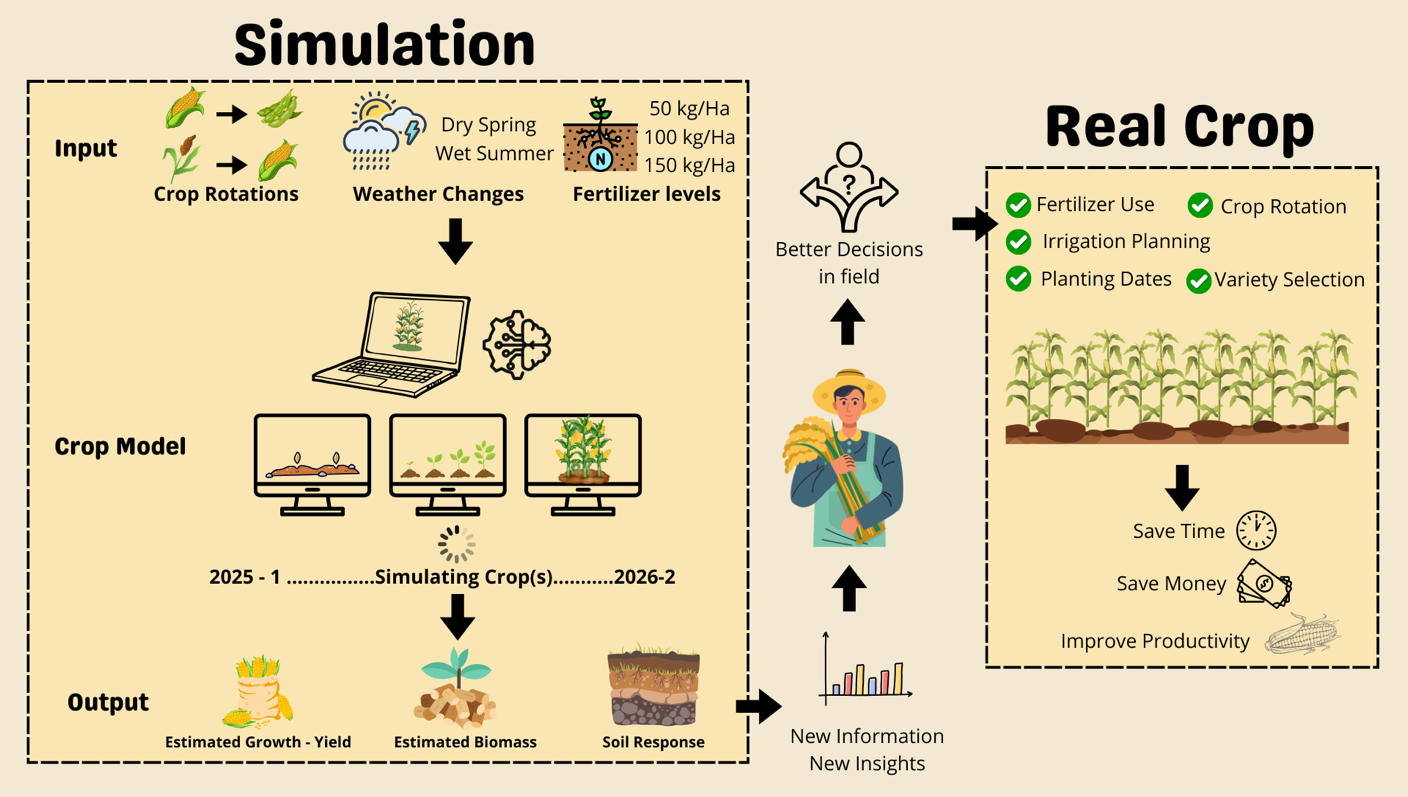
These models are used to test ideas, and simulate different scenarios, without spending resources or time in the field: for example, you can see what happens if you apply more or less fertilizer, if the weather turns drier or wetter, if you change planting dates, or if you rotate crops differently. It shows which practices give the best results in a given year and long-term, and how the crop would perform before even planting it. This way, we can plan ahead and fine-tune decisions to make the most of every season.
Crop Modeling in Indiana
Maize crop models have been applied for multiple purposes, providing valuable insights into which practices are implemented in both research and production, and current efforts are underway in Indiana. At Ciampitti's Lab, we are developing a workflow that will allow us to run several thousands of simulations and generate a dataset capturing how maize responds to different conditions of climate, soil, nutrition, irrigation, and more across the state of Indiana and the US Midwest region. Studies like this have already been conducted in Illinois (Mandrini et al., 2022) and other states.
The insights from these simulations can help farmers make more informed decisions regarding the purchase and use of nitrogen fertilizers.
What Comes Next
Crop models still have a long way to go. They don't always represent what happens on each farm or plot. For example, the soil data they use is often estimated, not actual measurements, and this means the results are not as accurate for each producer.
Today, areas such as artificial intelligence, satellite imagery (remote sensing), and new technologies for measuring plant growth can significantly help make them more accurate.
Similarly, we also need ground truth data. To achieve this, field experimentation must go hand in hand with computer modeling. Models can help us generate ideas for new trials, and the results will be used to improve future models.
But none of this would be possible without the support and participation of farmers, who face the real-world challenges under field conditions and have the experience we need to continue improving agriculture in this century.
References
Mandrini, G., et al. (2022). Simulated dataset of corn response to nitrogen over thousands of fields and multiple years in Illinois. Data in Brief.
Vasco, J., & Giller, K. (2021). Grand challenges for the 21st century: what crop models can and can't (yet) do. The Journal of Agricultural Science.