
Priscila B. Cano, Ignacio A. Ciampitti
Originally published in The Kernel – Indiana Corn Update, Issue #24 (October 6, 2025), Purdue University Department of Agronomy.
The adoption of new digital technologies is bringing about an unprecedented transformation in corn farming in the United States. These technologies are adopted to increase long-term productivity and reduce environmental impact.
Technological innovations are key drivers of operational efficiency and competitiveness in corn production. These innovations span multiple domains, including data acquisition and communication systems that facilitate information collection; computing infrastructure that enables efficient processing; and artificial intelligence that identifies critical patterns for decision-making. Integrating automation, robotics, biotechnology, and resource management technologies creates a comprehensive ecosystem that supports sustainable, efficient corn farming.
From biotechnology to artificial intelligence (AI), innovations are changing the way we grow corn. But where exactly is this innovation happening? To answer this question, our team analyzed over 32,000 U.S. agricultural patents issued between 2014 and 2024. We mapped the landscape of applicable corn technology and identified emerging trends that will shape the future of corn cultivation.
Eight Categories of Agricultural Technology
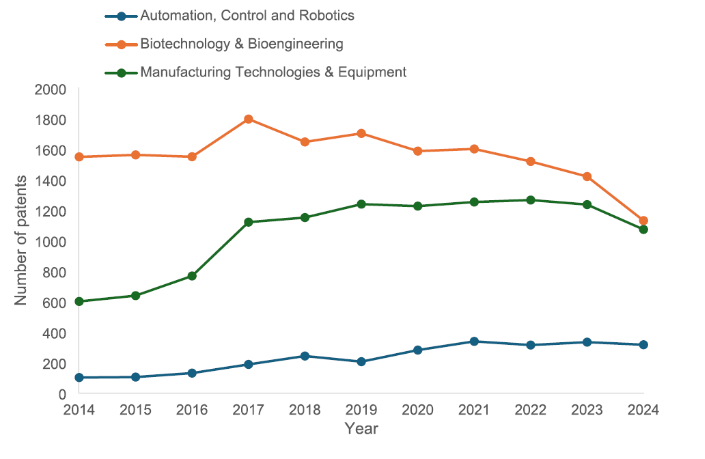
We classified patents into eight key categories that reflect the diversity of digital agricultural technologies (Figure 1).
Biotechnology & Bioengineering (53%)
The dominant category encompasses plant breeding, genetic improvements, and biological innovations. These patents focus on developing crop varieties with specific traits that improve productivity and resilience. For instance, they involve the development of drought-tolerant hybrids and nitrogen-efficient corn varieties that reduce fertilizer requirements.
Manufacturing & Equipment (36%)
Advanced agricultural machinery, actuators, materials, and equipment. This category has seen steady growth, reflecting the mechanization and modernization of farming operations. For example, planter technology achieving planting speeds up to 10 mph.
Automation, Control & Robotics (8%)
Technologies for monitoring, controlling, and automating farm operations. This category shows a major growth and represents the future of automation in farming. For example, a system that uses computer vision to distinguish corn plants from weeds, applying herbicides only where needed and autonomous grain cart systems that coordinate with combines during harvest, reducing labor needs during peak season.
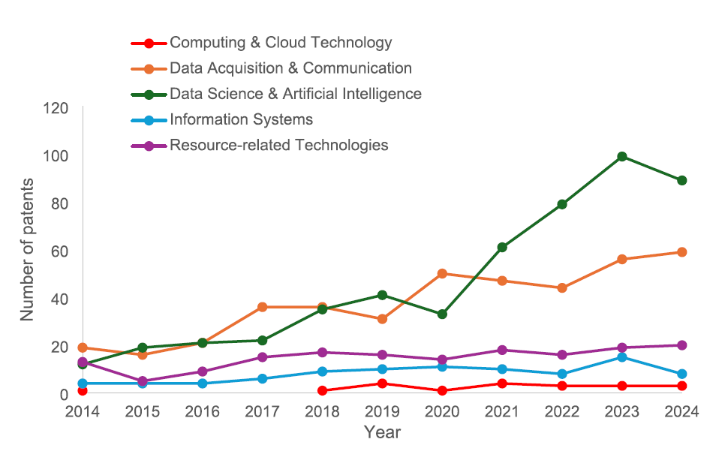
The remaining categories were identified at a relatively low frequency (Figure 2).
Data Acquisition & Communication (1.3%)
Covers processes related to data collection, processing, storage, and transmission, including image acquisition, remote sensing, sensor technologies, and data transmission. For example, high-resolution aerial imaging that detects individual corn plant health issues, pest damage, and nutrient deficiencies at early growth stages and soil sensor that provides field-specific data on moisture and temperature.
Data Science & Artificial Intelligence (1.3%)
It involves tools for deep data analysis using scientific methods and AI algorithms. These tools include AI-powered corn yield forecasting models and machine learning algorithms that recommend the best corn hybrid selection based on field characteristics and historical performance.
Computing & Cloud Technology (0.06%)
It includes tools and applications for storing and processing data on remote servers, including networks, databases, and software. One example is a cloud-based farm management platform that integrates corn scouting data, input applications, and financial records.
Information Systems (0.3%)
This category includes organized systems of interrelated components—including hardware, software, networks, and people—that collect, process, store, and distribute information to support decision-making and management. One example is software that plans variable-rate seeding prescriptions based on soil types and yield history in corn fields.
Resource-related Technologies (0.05%)
This category includes innovations that focus on managing and optimizing natural resources. These innovations cover smart agricultural buildings, carbon capture, renewable energy, soil and environmental conservation, and efficient water and waste management.
Our network analysis revealed that agricultural technologies are highly interconnected. This interconnection means that future innovations will likely emerge from combining technologies rather than advancing them in isolation.
Conclusion
The pace of agricultural innovation is accelerating, albeit unevenly. The digital divide presents a significant opportunity.
The interconnected nature of these technologies means that the most successful innovations will likely come from integrated approaches that combine multiple technological domains.
As digital technologies continue to advance, how farmers and innovators embrace these integrated solutions will define the next era of corn production in the United States.
Full article: Precision Agriculture (2025) 26:59. https://doi.org/10.1007/s11119-025-10257-x