
Leonardo Bosche, Federico Gomez, Ignacio Ciampitti
Originally published in The Kernel – Indiana Corn Update, Issue #22 (September 19, 2025), Purdue University Department of Agronomy.
Nitrogen (N) management in corn remains one of the biggest challenges for Midwest farmers, as the amount of N the crop requires depends on many interacting factors, including soil type, weather conditions, and the growth stage of the corn plant (Briat et al., 2020). Getting the correct N rate to apply at the right time is critical for maximizing yield, reducing costs, and protecting the environment.
Early in the season, corn takes up little N. After the sixth-leaf stage (V6), uptake increases quickly and peaks around flowering, when the crop requires the most N to build leaves and biomass. Later in the season, uptake slows down as the plant moves N from leaves and stems into the kernels. The challenge is ensuring the crop receives enough N when it requires it most, while avoiding overapplication.
Application of more N than needed could be common due to potential fear of losing yield (Houser, 2022). However, new tools may help to improve N decision-making process. Sensing technologies can now detect if the crop is short on N, giving farmers real-time information to guide in-season applications. Our project at the Agronomy Center for Research and Education (ACRE) in West Lafayette, IN, during the 2025 season is exploring one of these tools to see how they can support better N decisions in corn cropping systems.
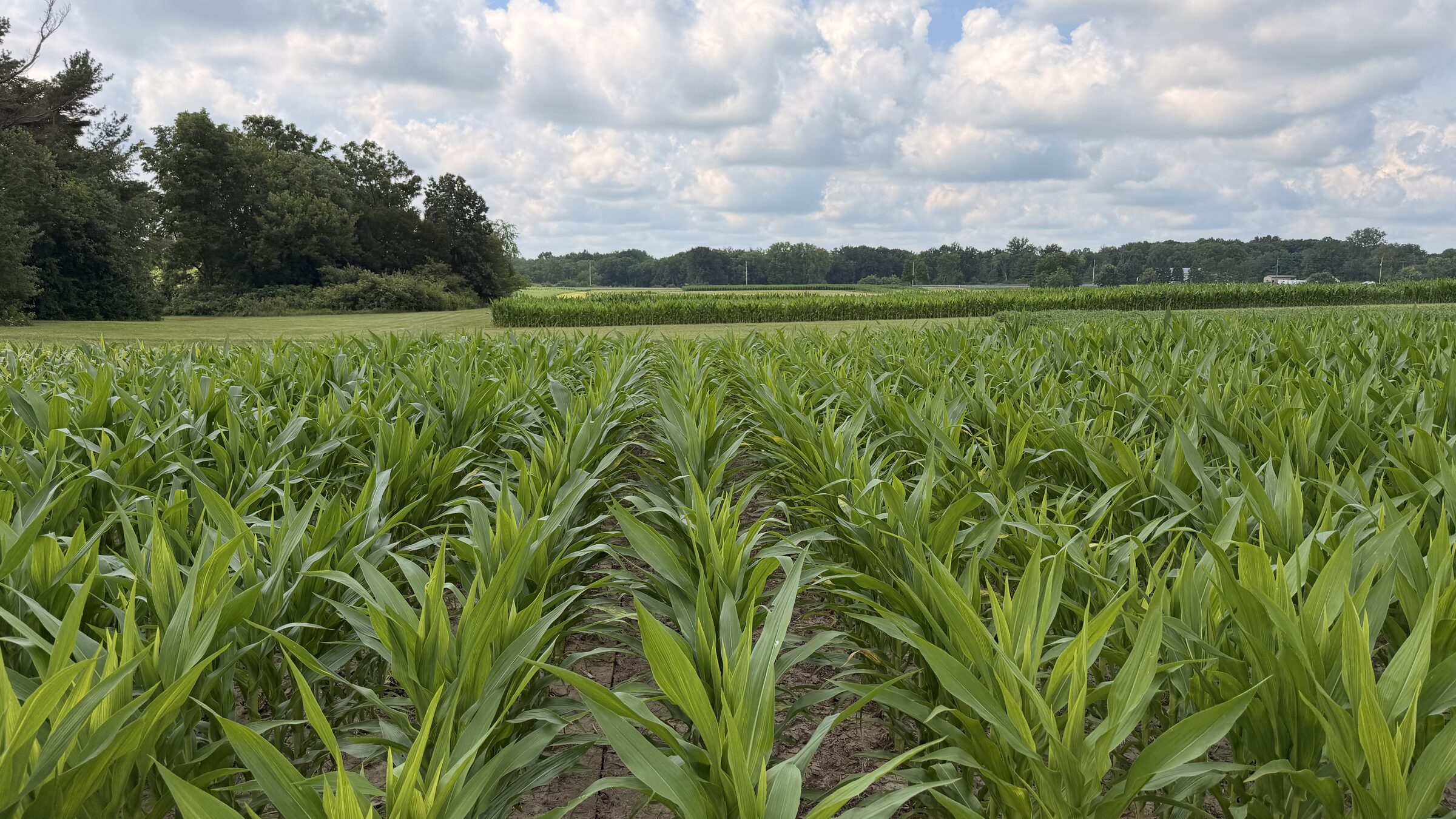
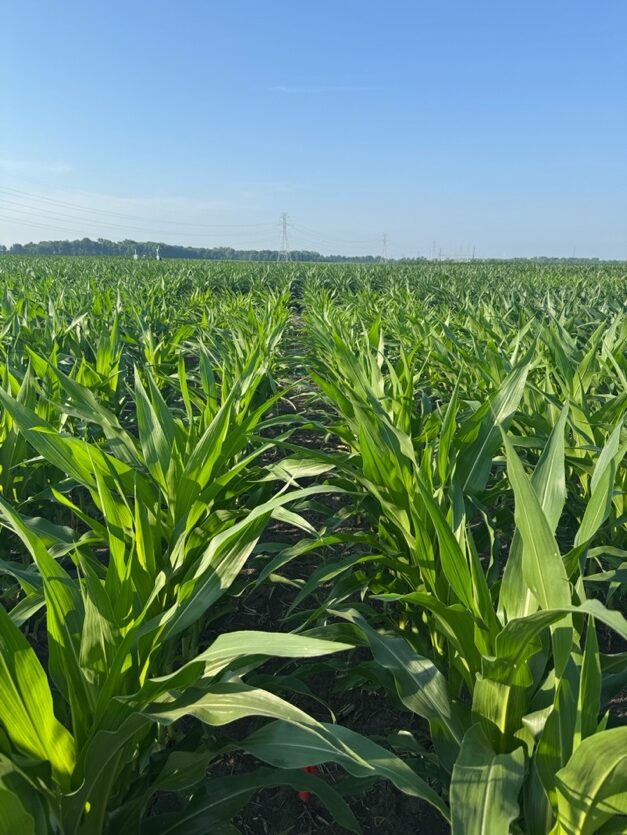
Our field trial this year includes six different N rates and two corn hybrids. One is a short-stature hybrid (PR111-20SSC), and the other is a tall hybrid (DKC62-70). The applied N rates range from 0 (control) up to 240 pounds of N per acre. This setup allows us to create different scenarios of N supply, from severe N stress to full N availability. By including the short-stature hybrid, we are also testing a new technology, which may show different characteristics compared to traditional tall corn.
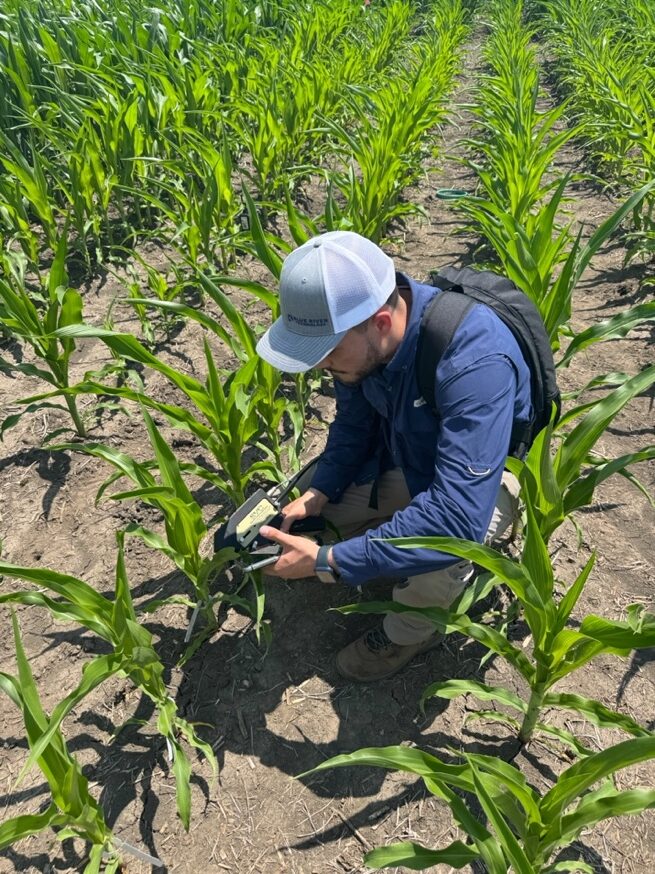
Throughout the growing season, a field-portable, high-resolution spectroradiometer (SVC 1024i model, made by Spectra Vista Corporation) was used to obtain hyperspectral data at the main physiological crop growth stages. Data were collected from the most developed leaf at the V9 growth stage, and from the ear leaf 15 days before flowering and at flowering. The sensor works by capturing how corn leaves reflect sunlight across hundreds of narrow wavelengths, creating a detailed "spectral fingerprint" of the plant. These fingerprints allow us to detect subtle changes in leaf color and structure linked to crop N status. Our goal in using this technology is to identify when and where N is limited. This information can help us use fertilizer more efficiently, improve yields, and reduce N losses to the environment.
While we are currently focused on N, this type of technology has much broader applications. Spectral sensors can also help to detect other nutrient stresses, as well as crop issues, such as drought (Burnett et al., 2021), disease (Lowe et al., 2017), or insect damage (Garcia Furuya et al., 2021), often before they become visible to the eye. In addition, the data collected on the ground can be used as a benchmark for data derived from drones and satellites, thereby improving the accuracy of aerial scouting tools that many farmers already use.
Our main goal in conducting this research is to explore the practical applications of hyperspectral sensing for developing more effective diagnostic tools for agronomists and farmers. By analyzing the detailed light signals reflected by corn leaves, we aim to more precisely identify crop N status at earlier crop growth stages. Earlier and more accurate diagnostics allow farmers to make better decisions about when and how much N to apply, supporting higher efficiency, stronger yields, and improved long-term productivity.
References
Briat, J.-F., Gojon, A., Plassard, C., Rouached, H., Lemaire, G., 2020. Reappraisal of the central role of soil nutrient availability in nutrient management in light of recent advances in plant nutrition at crop and molecular levels. Eur. J. Agron. 116, 126069. https://doi.org/10.1016/j.eja.2020.126069
Burnett, A. C., Serbin, S. P., Davidson, K. J., Ely, K. S., Rogers, A., 2021. Detection of the metabolic response to drought stress using hyperspectral reflectance. J. Exp. Bot. 72(18), 6474–6489. https://doi.org/10.1093/jxb/erab255
Garcia Furuya, D.E., Ma, L., Faita Pinheiro, M.M., Georges Gomes, F.D., Gonçalvez, W.N., Junior, J.M., de Castro Rodrigues, D., Blassioli-Moraes, M.C., Furtado Michereff, M.F., Borges, M., Alaumann, R.A., Ferreira, E.J., Osco, L.P., Marques Ramos, A.P., Li, J., de Castro Jorge, L.A., 2021. Prediction of insect-herbivory-damage and insect-type attack in maize plants using hyperspectral data. Int. J. Appl. Earth Obs. Geoinformation 105, 102608. https://doi.org/10.1016/j.jag.2021.102608
Houser, M., 2022. Farmer motivations for excess nitrogen use in the U.S. Corn Belt. Case Stud. Environ. 6, 1688823. https://doi.org/10.1525/cse.2022.1688823
Lowe, A., Harrison, N., French, A. P., 2017. Hyperspectral image analysis techniques for the detection and classification of the early onset of plant disease and stress. Plant Methods 13, 80. https://doi.org/10.1186/s13007-017-0233-z